



Jeep Wrangler Rubicon vs Sahara Comparison: Which Trim Fits Your Adventure?
The Jeep Wrangler has spent more than 80 years earning its reputation as one of the most capable and recognizable SUVs on the planet. But when it comes to choosing between two of its most popular trims, the Jeep Wrangler Rubicon vs Sahara comparison can feel a little overwhelming. Both trims are built on the same legendary platform, but they’re designed for different drivers. Understanding what sets them apart will help you make the right call on which one is right for you.
What Makes the Rubicon Built for Serious Off-Roading
The Rubicon is the undisputed off-road champion of the Wrangler lineup, and it earns that title through a long list of hardware upgrades. It comes standard with Dana 44 heavy-duty front and rear axles, which offer significantly more strength and durability than what you’ll find on lesser trims. These axles are paired with a Rock-Trac® four-wheel-drive system featuring a 4:1 low-range gear ratio, giving the Rubicon exceptional crawl capability on the most challenging terrain.
The Rubicon also benefits from front and rear locking differentials, which allow both wheels on an axle to spin at the same speed regardless of traction. This is a critical advantage when you’re driving on uneven rock surfaces or in deep mud. Add in a disconnecting front sway bar that allows for greater wheel articulation, and the Rubicon can flex its suspension in ways that keep all four tires planted even on wildly uneven ground.
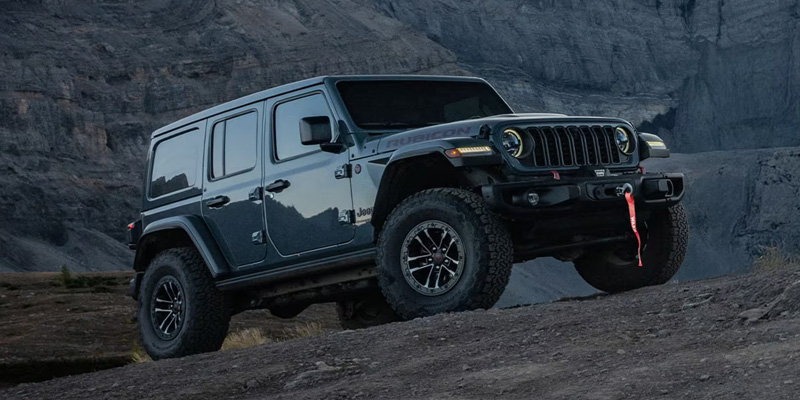
The Rubicon’s 33-in mud-terrain tires and lifted suspension speak for themselves. Ground clearance reaches 10.8 in, giving you plenty of room between the undercarriage and whatever the trail throws at you. The Rubicon is genuinely built to handle trails that would stop most other vehicles in their tracks.
What the Sahara Brings to the Table
The Sahara is where comfort meets genuine trail capability. It’s the Wrangler for drivers who want the open-air experience and authentic Jeep character without the raw, uncompromising nature of the Rubicon. The Sahara rides on all-terrain tires and delivers a noticeably smoother experience both on the highway and around town.
Rather than Dana 44 axles, the Sahara uses Dana 30 front and Dana 35 rear axles, which are more than adequate for moderate off-road use but aren’t designed for the kind of abuse the Rubicon can absorb. The Sahara comes with the Command-Trac four-wheel-drive system, which offers part-time four-wheel-drive operation and a 2.72:1 low-range ratio — capable, but less aggressive than the Rubicon’s setup.
For drivers who spend most of their time on paved roads but still want the freedom to explore fire roads, gravel paths, and light trails on the weekends, the Sahara is a genuinely satisfying choice. It offers a more car-like ride quality without sacrificing the Wrangler’s iconic personality. It’s also often better equipped with comfort-focused amenities right from the factory.
Roof and Open-Air Options on Both Trims
One of the most defining features of any Wrangler is its ability to open up to the elements, and both the Rubicon and Sahara give you options in that department. Both trims are available with the traditional removable hard top or the soft top, and both support the Freedom Top modular hard top that lets you remove individual panels over the front seats.
The Sahara is the trim most commonly paired with the premium Sky One-Touch Power Top, which is a powered soft top that opens and closes with a single button. This feature is a popular choice for drivers who want the convenience of an open-air feel without wrestling with manual latches and fabric. The Rubicon also supports open-air configurations, though its buyers tend to prioritize capability hardware over convenience features.
Both trims support door removal, which remains one of the most uniquely Jeep experiences you can have. If you’re cruising through downtown or heading down a dusty trail, the ability to completely open up your Wrangler is a feature that few other vehicles offer at any price point.
Real-World Capability: Which Trim Should You Choose?
Answering the Jeep Wrangler Rubicon vs Sahara comparison ultimately comes down to where and how you plan to drive. If you’re regularly tackling serious off-road trails, rock crawling, or remote backcountry terrain, the Rubicon’s locking differentials, disconnecting sway bar, and Dana 44 axles give you tools the Sahara simply doesn’t have. For those who want to know which Jeep Wrangler trim is best for off-roading in demanding conditions, the Rubicon is the clear answer.
That said, the Sahara is no slouch. It handles the vast majority of off-road situations, and it does so while delivering a more comfortable everyday driving experience. For drivers who split their time between daily commutes and weekend adventures, the Sahara offers an excellent balance without requiring the premium that comes with Rubicon-level hardware.
Think honestly about your typical weekend — are you navigating rock gardens and steep descents, or are you exploring scenic dirt roads and occasional creek crossings? Your answer should guide your choice more than any spec sheet.
Come Find Your Wrangler in Breese, IL
No matter if the Rubicon’s off-road-ready hardware speaks to you or the Sahara’s blend of capability and comfort feels like a better fit, K & J Chrysler Dodge Jeep RAM is ready to help you find the right match. Drivers throughout Breese, IL can explore both trims in person and get the answers they need to make a confident decision.
The Jeep Wrangler Rubicon vs Sahara comparison is a great starting point, but nothing replaces sitting behind the wheel. Stop by and see what the Wrangler lineup has waiting for you.
Connect with us


- July 2026
- June 2026
- May 2026
- April 2026
- March 2026
- February 2026
- January 2026
- December 2025
- November 2025
- October 2025
- September 2025
- August 2025
- July 2025
- June 2025
- May 2025
- April 2025
- March 2025
- February 2025
- January 2025
- December 2024
- November 2024
- October 2024
- September 2024
- August 2024
- May 2024
- January 2024
- August 2023
- April 2023
- March 2023
- January 2023
- December 2022
- November 2022
- September 2022
- June 2022
- April 2022
- September 2021
- June 2021
Archives
- Breese Chrysler Dealer
- Breese Chrysler Service
- Breese Dodge Dealer
- Breese Jeep Dealer
- Breese Ram Dealer
- Chrysler
- Chrysler Pacifica
- Community Involvement
- Dodge
- Finance
- Green
- Inventory
- Jeep
- K & J Chrysler Dodge Jeep Ram Service
- Local Events & Attractions
- New Inventory
- News
- People
- Pre-Owned Inventory
- RAM
- RAM 1500
- RAM 2500
- Service
- Social
- SUV
- Technology
- Wagoneer